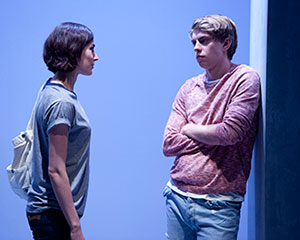
 Left – Geraldine Hakewill and Harry Greenwood. Cover – Robert Menzies and Sarah Peirse. Photos – Lisa Tomasetti
Righteousness is like a concrete bunker, which is both a safe place to live and also provides evidence that the outside world may not be such a safe place to live.
Joanna Murray Smith’s Fury wrestles with issues of responsibility, ownership of action (and inaction): the rights and responsibilities of a civil society to act upon or to tolerate philosophical/spiritual/ethical differences and the perennial problems associated with the passions of youth.
Successful, white, middle class couple Alice (Sarah Peirse) and Patrick (Robert Menzies) are still passionately in love after over twenty years of marriage. They are enjoying the spoils that come with hard work: professional acknowledgement, accolades and a profile piece in the university newspaper by a bright-eyed and well-researched student journalist (Geraldine Hakewill) and the safety of their opinions as representing the ultimate in global compassion and tolerance.
A neuroscientist who drives the concept of hard determinism in the form of DNA and chemistry, Alice believes in her work which reveals the inextricable and unavoidable destiny our brains decide. Altruism drives Alice into a moral high ground where scientific discovery is not sold for personal gain. Patrick plays down his literary success. Their son, Joe (Harry Greenwood) is a high achiever at a private school. The family is firmly embedded in an ivory tower, or in this production a concrete bunker (designed by David Fleischer) ideas fuel this family.
However, despite this self made intellectual utopia – all is not as easy on the home front. When Joe is discovered to have defaced a mosque, the very essence of the root cause and responsibility of the action traces back to his parents.
Who is ultimately responsible when an act of protest or terrorism occurs?
When eyes are cast towards Joe’s school chum Trevor – the working class football scholarship kid – his parents Annie (Claire Jones) and Bob (Yure Covich) offer a counterpoint to the rights and righteousness of intellectuals.
This is a play in which the bulk of the central exploration is how people articulate their struggles with weighing what is right against what is tolerable and what is wrong. This is an ideas play in which Joanna Murray Smith offers us a conversation which attempts to uncover more than a class struggle – but attempts to explore hypocrisy on an ideological level.
Andrew Upton has kept the production’s focus on the strength of the dialogue and the agenda and ideas within – and has limited stage action to essential stage craft erring on the minimal. This is not a production full of visual flourish and naturalistic effect – but instead an economical presentation of ideas, seeking to wrench open practical and philosophical assumptions with Joanna Murray Smith’s sharp conversational talons.
But the central concern is not that of lofty intellectualism, nor of navel gazing but of the true nature of unconditional love.
Joanna Murray Smith’s Fury is a well thought out play of ideas reliant on Upton’s cast to present view points and perspective which may not be easy to hear – perhaps because of it’s didacticism, or perhaps because the familiarity of the rhetoric. However, it is a clear conversation and one worth having. There may be no grand flights of fancy – and sometimes with art familiarity breeds contempt – but this is a stimulating topic which holds everyone accountable for their perspectives (especially for those who are ready to confront their sense of justice or righteousness).
This is a conversation starter which questions the nature of unconditional love, forgiveness and philosophical righteousness.
Sydney Theatre Company presents
FURY
by Joanna Murray-Smith
Director Andrew Upton
Venue: Wharf 1, Sydney Theatre Company, Pier 4/5 Hickson Road, Walsh Bay
Dates: 15 April – 8 June 2013
Tickets: $50 – $95
Bookings: 02 9250 1777 | sydneytheatre.com.au
Sydney Reviews
Fury | Sydney Theatre Company
- Details
- Augusta Supple
Most read Sydney reviews
The Lark | Hey Dowling
Noni Hazlehurst brings Rose and The Lark to colourful and compelling life in this one-woman show.
Pride & Prejudice* (*sort of) | Neil Gooding Productions & Woodward Productions
This rollicking musical take on Jane Austen’s beloved novel is a side-splitting crowd pleaser.
Heartbreak Hotel | EBKM
Heartbreak Hotel invites its audience into an intimate portrait of the universal and isolating experience of heartbreak.
Current | Sydney Dance Company
While Bonachela’s work is, as always, dreamily lovely, for me the highlights were absolutely the three commissioned choreographers: Azzam Mohamed, Jenni Large and Raghav Handa.
The Gospel According to Paul – The Second Coming | Soft Tread Productions
The Gospel According to Paul is meticulously crafted entertainment. It’s uplifting without pulling any punches.
The Gospel According to Paul is meticulously crafted entertainment. It’s uplifting without pulling any punches.

While Bonachela’s work is, as always, dreamily lovely, for me the highlights were absolutely the three commissioned choreographers: Azzam Mohamed, Jenni Large and Raghav Handa.